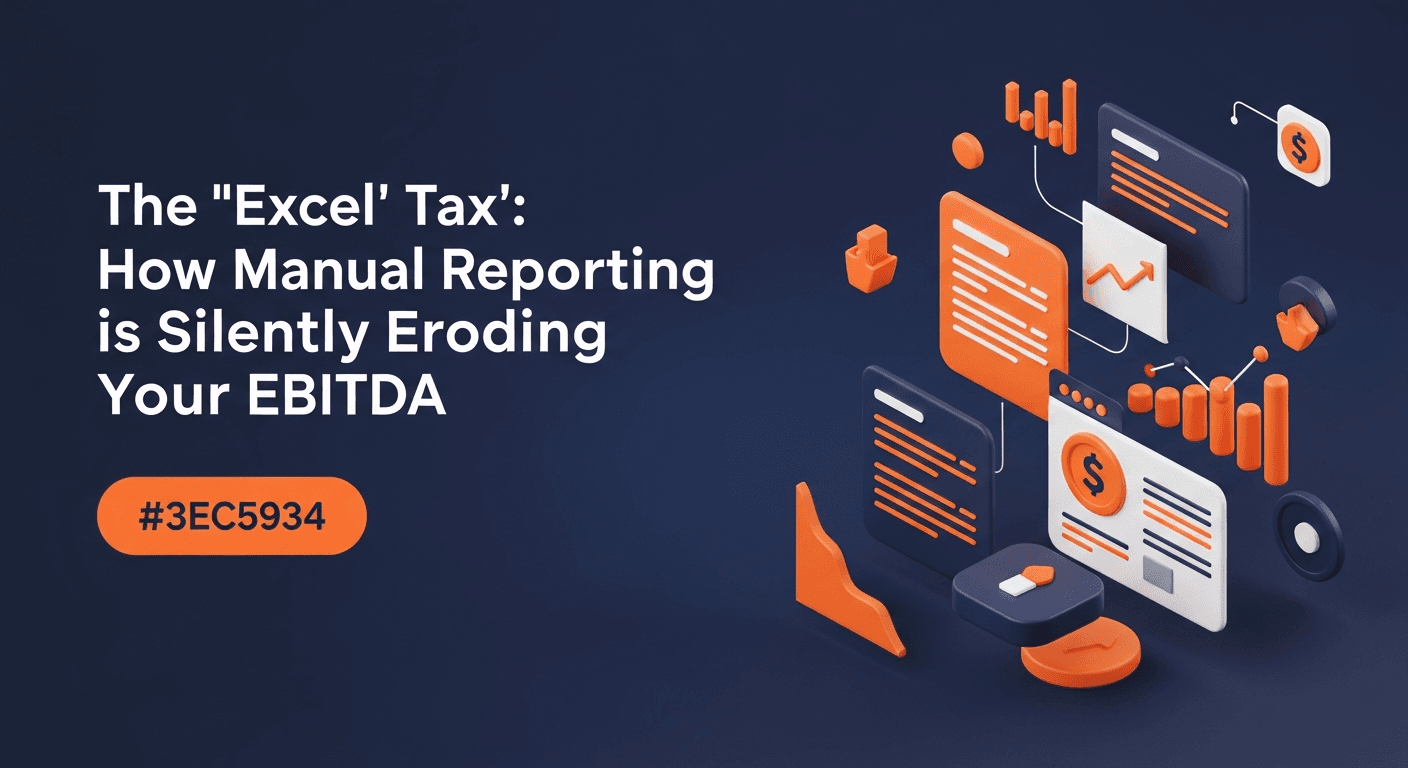
The "Excel Tax": How Manual Reporting is Silently Eroding Your EBITDA
"If you can’t measure it, you can’t manage it." – Peter Drucker.
For most Australian mid-market firms, "Business Intelligence" isn't a sophisticated software suite; it’s a collection of 45 different spreadsheets, held together by a single manager who knows exactly which VLOOKUP is broken.
We call this Excel Hell, and it carries a very real, very hidden financial burden: The Excel Tax.
What is the Excel Tax?
The Excel Tax is the cumulative cost of manual data manipulation. It’s the difference between what your staff costs you and the actual value they provide. When your Finance Manager, Operations Head, or Sales Lead spends Monday morning exporting CSVs from Xero, Salesforce, and your warehouse logs, you aren't paying for leadership—you’re paying for highly-compensated data entry.
In a 2026 landscape where AI-driven competitors are reacting to market shifts in minutes, a business running on "last month's numbers" is effectively flying blind with a 30-day lag.
The Anatomy of Friction: Quantifying the Erosion
To understand how this erodes your EBITDA (Earnings Before Interest, Taxes, Depreciation, and Amortization), we have to look at the three pillars of data friction:
1. The Direct Labor Leak
Most businesses underestimate the time spent on "data plumbing."
- The Math: If five managers spend just 4 hours a week exporting, cleaning, and formatting reports, that’s 1,040 hours per year.
- The Cost: At an average burdened rate of $120/hr, that is $124,800 per year spent just to see what happened in the past.
2. The "Decision Lag" Penalty
Data has a half-life. The value of knowing your Customer Acquisition Cost (CAC) is highest the moment the spend happens. By the time that data is manually reconciled three weeks later, the opportunity to pivot your marketing spend has vanished. This "Decision Lag" results in wasted OpEx that never shows up as a specific line item, but quietly suppresses your margins.
3. The Single Point of Failure
"Excel Hell" usually relies on a "Key Person." If the person who built your master reporting sheet leaves, they take the logic, the formulas, and the "source of truth" with them. Replacing that tribal knowledge is an expensive, high-risk endeavor.
The Solution: Building a Digital Moat
Breaking the cycle of the Excel Tax doesn't require a multi-year "Digital Transformation" project that ends in failure. It requires a shift from Descriptive reporting to Automated intelligence.
At Firehawk, we utilize the SmartEngine—a proprietary architecture designed to automate the "plumbing" of your data in 48 hours. By connecting your disparate systems (ERP, CRM, Finance) into a single, automated stream, we move your team from:
- Cleaning Data → Questioning Data
- Reporting History → Predicting Trends
- Manual Error → Systemic Accuracy
The 48-Hour Pivot
The goal of modern Business Intelligence isn't just to have "prettier charts." It is to reclaim the 20% of your leadership team's brainpower currently trapped in spreadsheet maintenance.
When you automate your reporting, you aren't just saving time; you are building a Digital Moat. You are creating a defensible asset—bespoke software and data logic that you own entirely—that makes your business faster, leaner, and ultimately, more valuable to investors.
Stop paying the Excel Tax. It’s time to own your insights.
Key Takeaways for Your Next Board Meeting:
- Audit the Hours: Ask your team how many hours are spent "preparing" vs. "acting" on reports.
- Identify the Silos: Map out how many different logins are required to get a full picture of company health.
- Calculate Friction: Use the $Friction Loss$ formula to see the impact on your bottom line.
Further Reading

NDIS Providers and the 2025 Margin Squeeze: Why Healthcare Analytics is the Key to Survival
Read article→
Xero's API "Tax": How to Beat the Overage Sting
Xero is retiring its "all-you-can-eat" API model and introducing a new tiered system that could cost your business thousands in data overage fees. But you don't have to choose between your budget and your business intelligence. Firehawk Analytics has engineered a quick and easy solution to bypass these mounting costs while keeping your real-time insights intact. Learn how to optimize your data flow and beat the overage sting before the new rules kick in.
Read article→
How to Use LLMs to Identify and Automate Key Performance Indicators (KPIs)
Discover how Large Language Models (LLMs) are revolutionizing business intelligence by identifying hidden KPIs within unstructured data and automating performance tracking for smarter decision-making.
Read article→